10 Reasons why your cycle is getting shorter & when to consult a doctor

Freya Eriksson

Agathe van Lamsweerde

Follows NC° Editorial Policy
At Natural Cycles, our mission is to empower you with the knowledge you need to take charge of your health. At Cycle Matters, we create fact-checked, expert-written content that tackles these topics in a compassionate and accessible way. Read more...
Key takeaways:
- The menstrual cycle naturally gets shorter over the course of our reproductive lives, and short cycles are common during the perimenopause transition
- Short menstrual cycles can also happen due to a number of reasons, such as stress, weight changes, or other lifestyle factors
- Talk to your doctor if you are worried about changes to your menstrual cycle
If you’re tracking your menstrual cycle, you’ve probably noticed that not every cycle looks the same, and perhaps that some are shorter than others. Short menstrual cycles are defined as cycles of 24 days or less, but what does it actually mean when our cycles become shorter? In this article, we’ll dig into the specifics of what short cycles mean, why they happen, and when to speak to your healthcare provider.
What is a short menstrual cycle?
Short menstrual cycles are usually defined as cycles lasting less than 21 days, counted from the first day of your period to the start of the next [1]. Other guidelines consider menstrual cycles to be short if they are under 24 days [2].
In reality, menstrual cycles vary in length, and anywhere between 21 and 35 days is considered to be within the normal range [1]. Your cycles will also vary in length from one month to the next, so it’s normal not to get your period after the exact same number of days each time. [2].
It’s also worth keeping in mind that we’re all different. Most of us have probably heard at some point that the standard cycle is 28 days long. In a study of over 600,000 cycles from Natural Cycles users, we found that only about 1 in 8 of the cycles included in the analysis were 28 days long. Less than 1% of cycles were shorter than 21 days [3]. Every person has their own unique cycle pattern, so what’s normal for you is not necessarily normal for someone else.
What is an irregular period?
Irregular periods mean that your menstrual cycles are either shorter than 21 days or longer than 35 days. It can also mean that your cycle length varies by more than seven to nine days [1]. So, while not all short menstrual cycles — cycles under 24 days — count as irregular, cycles under 21 days do.
Irregular periods can also refer to the bleeding itself. For example, if you have very heavy period bleeds, if you bleed between periods, or if your periods are very painful [1].
What decides how long a menstrual cycle is?
Your menstrual cycle starts on the first day of your period and continues until your next period starts. Each cycle can be divided into two main phases – the follicular phase and the luteal phase – with ovulation marking the transition between them.
The main factor determining how long a menstrual cycle will be is the timing of ovulation. Usually, the follicular phase is the longest phase – on average, it lasts about 17 days. This is also the phase that tends to vary in length, since ovulation doesn’t always happen on the same day in each cycle. The luteal phase, on the other hand, doesn’t change much from cycle to cycle, and it's about twelve days long. So, once you ovulate (regardless of when that happens), you can expect your period roughly two weeks later [3].
What is a short period?
Periods typically last up to seven days [1]. Same as with cycles in general, how long (and how heavy) our periods are can vary from person to person, and even from cycle to cycle.
If you notice big changes in your bleeding pattern, for example, if your periods suddenly become much shorter, longer, heavier, or lighter than usual, it can be a good idea to speak with your healthcare provider to check that everything is as it should.
Why is my cycle getting shorter?
So, what causes the menstrual cycle to get shorter? Interestingly, our cycles tend to become shorter as we get older. More research is needed to fully understand the mechanisms behind this, but it’s likely linked to how our hormones change with age [4]. However, it’s also worth noting again that menstrual cycles vary in length from one to the next, so it’s completely normal that some of your cycles are a bit shorter and some are longer, regardless of your age.
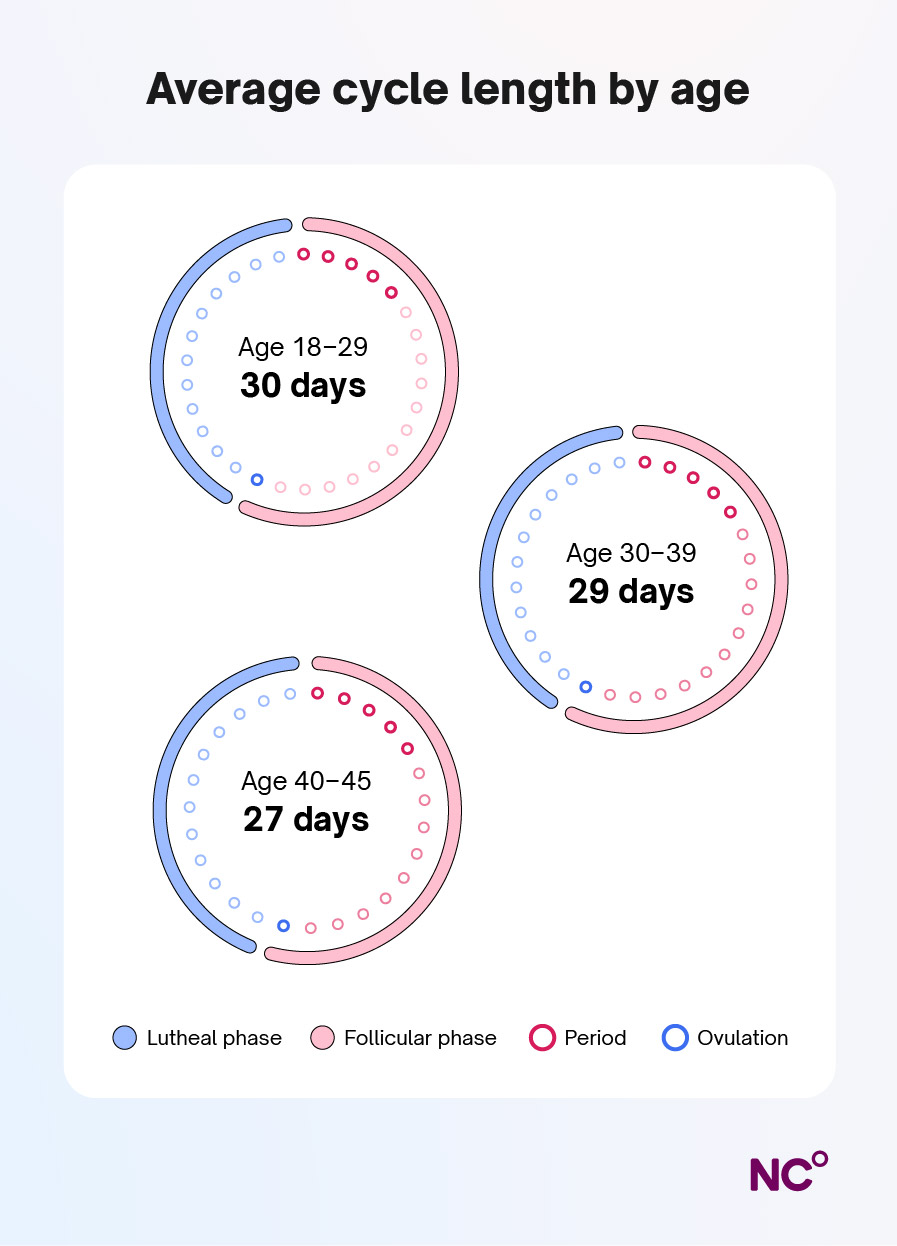
Our study of more than 600,000 cycles found that the average cycle length became about four hours shorter per year between the ages of 25 and 45. However, since that change is so small, most of us won’t notice it for a while – it would take about six years for the average cycle to become one whole day shorter [3].
The same study also found that the follicular phase got shorter over time, while the luteal phase length remained roughly the same. Cycles in the late teens and early twenties were 30 days on average, with an 18-day follicular phase. In the 30-39 age group, cycles were, on average, one day shorter (29 days) with a 16-day follicular phase. Between 40-45, the average cycle length was 27 days, with an average follicular phase length of 15 days [3].
This means that cycles often become shorter as we get older because ovulation happens earlier. Other research has also found the same relationship between ovulation, cycle length, and age [5].
Looking beyond averages, recent research on Natural Cycles data shows that short cycles (under 21 days) become more common as we get older. They are relatively rare (around 1% of cycles) throughout most of our twenties and thirties, and start to become more frequent in our early forties (the decade when we usually enter perimenopause, the transition leading up to menopause, when our periods stop). By the time we reach our late forties and early fifties, short cycles can account for 8 to 12% of all cycles. What's reassuring is that the majority of these cycles are still ovulatory: ovulation is happening, just earlier than usual. So while short cycles become more common during perimenopause, that doesn't mean ovulation has stopped [6].
10 Causes of a short menstrual cycle
Of course, many factors can lead to irregular cycles, including short cycles. Let’s take a look at a few common ones!
1. Age
When we first get our period as teenagers, our cycles tend to be irregular, and it’s not uncommon for them to be long as well. This usually evens out as we finish puberty. In our twenties and early thirties, we tend to have more regular cycles (some people, however, continue to have irregular cycles throughout their fertile years) [7].
When we approach our forties and enter perimenopause, irregular cycles start to become more frequent once again. During perimenopause, our cycles often get shorter at first, and then periods start to come less frequently as menopause (the very last period) approaches [7].
2. Stress
Stress can cause both shorter and longer cycles [8]. This is because stress can affect a variety of hormone levels, some of which, in turn, can disrupt the hormones that specifically govern the menstrual cycle. This can lead to problems with ovulation — for example, ovulation might happen earlier than usual (resulting in a short cycle), or be delayed (meaning a longer cycle). In some cases, ovulation may be skipped altogether, resulting in an anovulatory cycle [9, 10].
We all go through stressful periods in life now and then, and even if your cycle is affected by stress, it usually returns to normal once you come out on the other side. That being said, it’s always a good idea to speak to a healthcare provider if you’re worried or if you need extra support for your mental well-being — you don’t need to go through it alone.
3. Weight changes
Our weight is another factor that can affect the menstrual cycle. While the link between weight and the menstrual cycle isn’t entirely understood, research indicates that both high and low BMIs are associated with irregular periods [11]. Sudden weight changes can also affect the menstrual cycle [8]. It’s always a good idea to consult your healthcare provider if you have questions or concerns about your weight.
4. Excessive exercise
Regular exercise on its own is unlikely to cause cycle irregularities, and movement is good for our health. However, irregular cycles can happen if you exercise very hard and don’t give yourself enough time or nutrition to recover [12]. If that happens, it most likely results in delayed or missing ovulation and longer cycles, but short cycles are also possible if ovulation is disrupted.
It’s important to find a balance between physical activity and rest. If you’re ever unsure, you can always reach out to your healthcare provider for advice on how to best support your body.
5. Medical conditions
Some conditions, like PMOS (polyendocrine metabolic ovarian syndrome) — formerly called PCOS — or thyroid conditions, can also cause irregular menstrual cycles [8]. This might look like shorter or longer cycles than average, the length varying a lot from one cycle to the next, heavy bleeding, or bleeding between periods.
PMOS, specifically, is usually categorized by irregular cycles with infrequent periods. However, some research indicates that cycles, on average, become shorter and more regular with age for women with PMOS [13].
6. Hormonal birth control
Hormonal birth control can affect how often you bleed and also cause breakthrough bleeding, a type of spotting that happens between periods. Depending on how long your cycles were before you started on hormones, the induced cycles might seem shorter than you’re used to.
However, it’s worth keeping in mind that, in most cases, we don’t technically have a period while on hormonal birth control. These methods generally work by stopping ovulation, which means the menstrual cycle is paused while they are used. The bleeding you may experience, for example, during the placebo week if you’re on the pill, is a result of changing synthetic hormone levels and not of the natural changes that happen during the menstrual cycle [14].
7. Coming off birth control
When stopping hormonal birth control, it can take some time for your hormone levels to get back to how they were before you started on hormones. Though ovulation often returns within a few weeks up to a few months, it’s common to experience irregular cycles while your body finds its balance again. So, you might notice longer or shorter cycles than you’re used to. For most, this evens out within a few months, but it can take up to a year for the menstrual cycle to regulate completely after you come off hormones (it can also depend on which method you were using) [14].
8. Pregnancy
Pregnancy has a big impact on our hormones. If you’ve recently been pregnant, first off, it can take a while for your cycle to return, and it’s also common to have irregular cycles in the beginning and up to a year or more after giving birth [15, 16]. This might look like shorter or longer menstrual cycles than you’re used to, changes in bleeding patterns on your period (heavier or lighter flow), or more variation in cycle length from one cycle to the next.
As your body adapts and your hormone levels get back to their baseline, you can expect your cycle to return to your normal. If you’re using NC° Postpartum, a dedicated mode within the Natural Cycles app to help support your recovery, the app will let you know when your first ovulation happens and when you can expect your first period after giving birth.
Cycle irregularities are also common if you go through a miscarriage. In most cases, your period will return after around four to eight weeks, but you can expect your cycle to be a bit more irregular than normal for a while [17].
9. Breastfeeding
While breastfeeding, the body produces a hormone called prolactin, which stimulates milk production. This hormone also affects the menstrual cycle, and it’s common for periods to be absent altogether or be irregular while breastfeeding. Though more research is needed, the most likely explanation is that prolactin inhibits the hormones responsible for ovulation [18].
10. Anovulatory cycles
Another factor that can impact cycle length is whether ovulation happens at all. A cycle without ovulation is known as an anovulatory cycle, and these are likely to make your cycle vary in length [19]. Most of us will experience an anovulatory cycle at some point in our lives, but you might not realize it unless you are tracking biological markers of ovulation, such as basal body temperature.
Research has shown that, among younger women, cycles under 21 days are more likely to be anovulatory (though not all short cycles are anovulatory). However, during perimenopause, ovulation still happens in most short cycles [6].
What does a short menstrual cycle mean?
If your menstrual cycle is shorter than usual, that typically means that ovulation happened earlier than it normally does for you (since the luteal phase usually lasts for roughly the same number of days in each cycle).
This doesn’t need to mean anything in particular — cycles naturally vary, and it’s normal to experience some changes in cycle length. However, sudden, big changes to your cycle can indicate that something more is going on.
When should I see a doctor?
Each cycle is unique, and while they won’t all look the same, many of us recognize patterns within our own cycles, so we tend to notice if something changes drastically. Especially if we usually have a regular cycle, we’ll likely notice a sudden change in menstrual cycle length. You should contact your doctor if:
-
You have irregular cycles (shorter than 21 days or longer than 35 days)
-
You usually have regular cycles that suddenly become irregular
-
Your periods last longer than seven days, or they are very heavy
-
You have irregular cycles, and you’re struggling to get pregnant
-
You have irregular cycles along with other symptoms, such as weight gain, fatigue, and hair growth
-
You experience unusual bleeding during your cycle
If you feel worried about your own cycle, even if you don’t experience the symptoms described above, it’s always a good idea to reach out to a healthcare provider who can help you determine what’s going on.
Understand your body better with Natural Cycles
Here at Natural Cycles, we believe in empowering you with the knowledge you need to take control of your own health. Understanding your menstrual cycle and how ovulation affects its length can help you make informed decisions about your reproductive health. The Natural Cycles app is there to support you regardless of what your fertility journey looks like — whether you’re looking for a hormone-free birth control method, want to pinpoint your fertile days to get pregnant faster, follow a pregnancy or your recovery postpartum, or get support through perimenopause. See if Natural Cycles could be a good fit for you today.
Did you enjoy reading this article?
Frequently asked questions